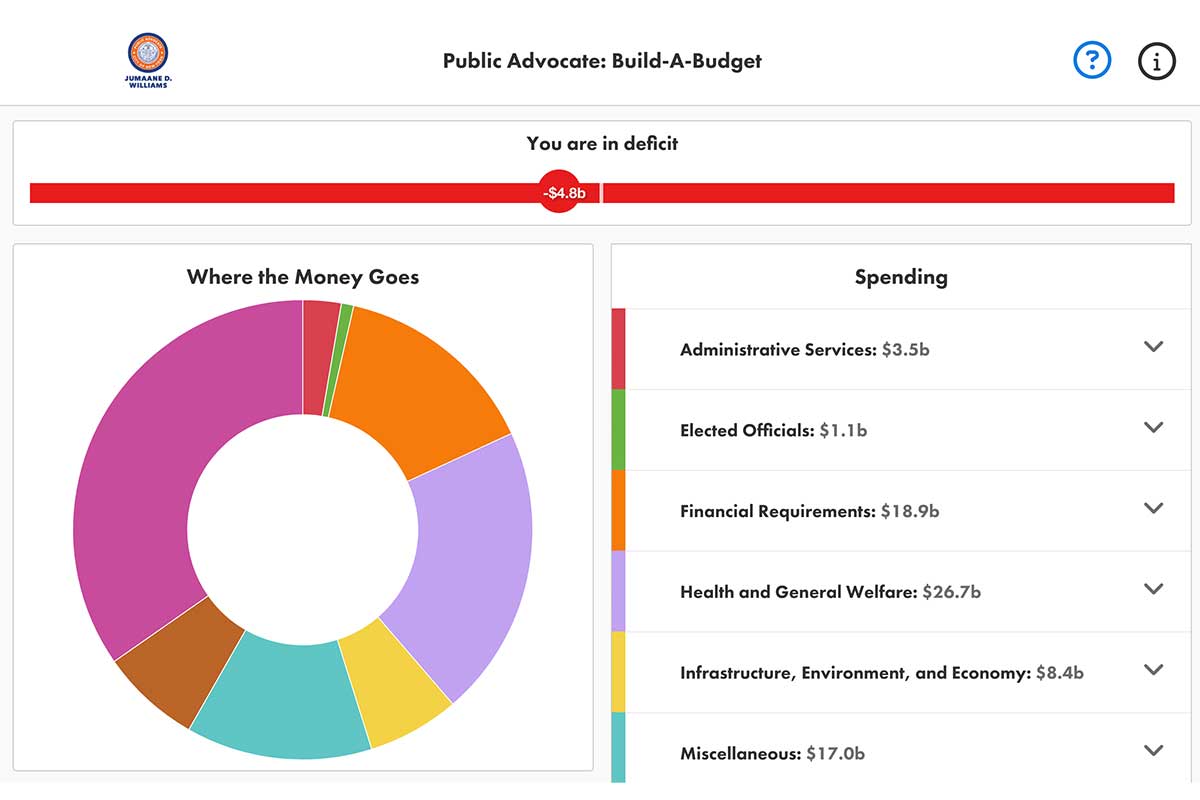
The city and state budgets are being negotiated as we speak. Billions of dollars are at stake. The budget process is often opaque, and the potential tradeoffs and implications can be difficult to navigate. Leaders have an obligation and opportunity to build a budget that benefits the people, and the people need a voice in creating that budget.
Now you can try for yourself – with our new ‘Build a Budget’ tool, you can visualize the way the city’s money is spent, where it comes from, and what goes into ensuring that it is balanced without slashing city services. Within the interface, users can raise and lower city expenditures across agencies and initiatives, and enact or reject revenue raising measures on the state level.
Rich donors try to build our budget behind closed doors – but you can do it right from your phone. Once your budget is balanced, submit it to our office to let us know how you want your money spent.
Balancing that budget means making up a multibillion deficit left by the previous mayor.
There are things the state could do right now to enable the city to not only close this budget gap, but implement programs that serve working families across our city for the long term, like Universal Childcare.
City Revenue Measures Controlled by the State
First, the state can authorize the city to raise revenue in several ways. These are just a few:
- The Fair Share Act would authorize the City Council to implement a 2% surcharge on personal income above $1 million for New York City residents. This bill would rectify New York City’s essentially flat income tax. It would raise about $3 billion per year. A poll released March 4th, 2026 finds that 62% of NYC voters and 72% of Democrats believe state leaders should approve this measure.
- Increasing the NYC Corporate Tax on the most profitable businesses would raise about $1.75 billion per year. The measures in the state legislatures’ one house budgets would raise the highest tax rates on financial firms with over $100 billion in assets from 9% to 10.8%, on non-financial firms with over $1 million in profits from 8.85% to 10.62%, and on unincorporated businesses with over4.4%.
- Reducing the NYC Pass-Through Entity Tax (PTET) credit to 75% from 100% would raise about $700 million per year. The PTET credit was created in reaction to the federal government’s implementation of State and Local Tax (SALT) credit caps and allows high income individuals to pass their income through a corporation to pay less in taxes. Reducing the credit percentage is a fair way to raise revenue.
- Implementing a Pied-à-Terre Tax would apply a tax increase on certain high-value properties in which there is no full-time primary resident. While the State bill would allow City Council to structure the actual pied-à-terre tax schedule, the Fiscal Policy Institute’s recommendation to gradually increase the rate from 0.5% for properties worth $5 million to 4% for properties worth $25 million or more would raise about $650 million each year. This measure could have the added benefit of inducing higher full-time NYC residency.
If the state fails to pass these measures, or in addition to them, the city can still raise revenue through the People’s Plan’s Make ‘Em Pay Campaign, which aims to recoup unpaid fines from lawbreaking landlords and corporations by increasing enforcement and collections staffing across several City agencies. Their plan could net the City billions in already owed fines and fees. These would be one time gains, not recurring revenue, but would improve quality of life by discouraging landlords and corporations from breaking the law in the future.
State Revenue Measures with Positive Impacts on NYC
There are additional state revenue-raising measures which would have indirect but significant benefit to the city. These measures would not directly add revenue to the City budget. However, by increasing revenue in the State budget, the City would likely receive some more funds or have some costs offset by the State. They include:
- A Progressive Income Tax Restructure would add 10 new tax brackets for the top 5% of earners to New York’s personal income tax schedule. It would raise over $21 billion annually for the State. A 2024 poll found 69% of New Yorkers and 77% of New York Democrats support this measure.
- Many of the highest-income New Yorkers make the majority of their money from investments. Raising the Capital Gains Tax to 7.5% on long-term capital gains over $500,000 and to 15% on capital gains over $1 million would raise about $12 billion in revenue for the State each year. Coincidentally, the richest New Yorkers are also set to receive $12 billion in federal tax cuts, so this tax would be a targeted method for recouping that revenue.
- New York State’s overall tax structure is regressive in that the methods through which the wealthiest New Yorkers receive their income, investments and inheritances, are undertaxed relative to regular working income. Restructuring New York’s Estate and Inheritance Taxes such that gifts and inheritances with more than $750,000 are taxed at 5% with rates increasing slowly to 50% for gifts and inheritances worth more than $30 million. Cumulatively, this measure would raise $8 billion for the State per year.
- Raise the Corporate Income Tax for the Most Profitable Companies. Many major corporations operating in New York have seen record profits while living expenses for average New Yorkers have skyrocketed. Raising the State’s corporate income tax would result in an additional $7 billion in revenue each year for the State. As originally written, the bill also reduces the State-level PTET credit to 75%. 67% of New Yorkers and 74% of Democrats support this measure, per the 2024 poll.
- Repeal the Gold Bars Tax Break. New York currently exempts bars, ingots, or coins of gold, silver, platinum, palladium, rhodium, ruthenium, or iridium with more than $1,000 from sales tax. Reversing this exemption would raise about $600 million in revenue for the State and $300 million for the City each year.
No matter how we do it, we have to close the city’s budget gap and balance the budget. It’s up to the governor who will pay the cost – working families or the richest New Yorkers – let us know how you’d balance the budget by submitting your results at Advocate.nyc.gov/BuildABudget.
The state budget is due on April 1, and the city budget is due on June 30.