Introduction
From Arnold Rothstein’s downtown poker empire to “numbers” games that funded Black communities in nineteenth century Harlem, New Yorkers have gambled in droves long before the practice was legal.[1] The New York Lottery became the first sanctioned gambling form in the state in 1967 and has since become the largest in the country. Off-track betting, on horse races for example, was legalized in 1970. In 2001, the state allowed a number of casinos on Native American reservations and permitted Video Lottery Terminals (VLTs), such as slot machines, on racetracks and some other venues, turning them into “racinos.” New York State took a major step when its legislature and voters approved a 2013 constitutional amendment legalizing commercial casinos upstate and allowing downstate casinos with a built-in 10 year delay.[2] Other permitted gambling opportunities went statewide with the legalization of online mobile sports betting in 2022. New York has become the national leader in online sports gambling over the last three years, with the highest volume of wagers and related tax revenue of any state in the country.[3]
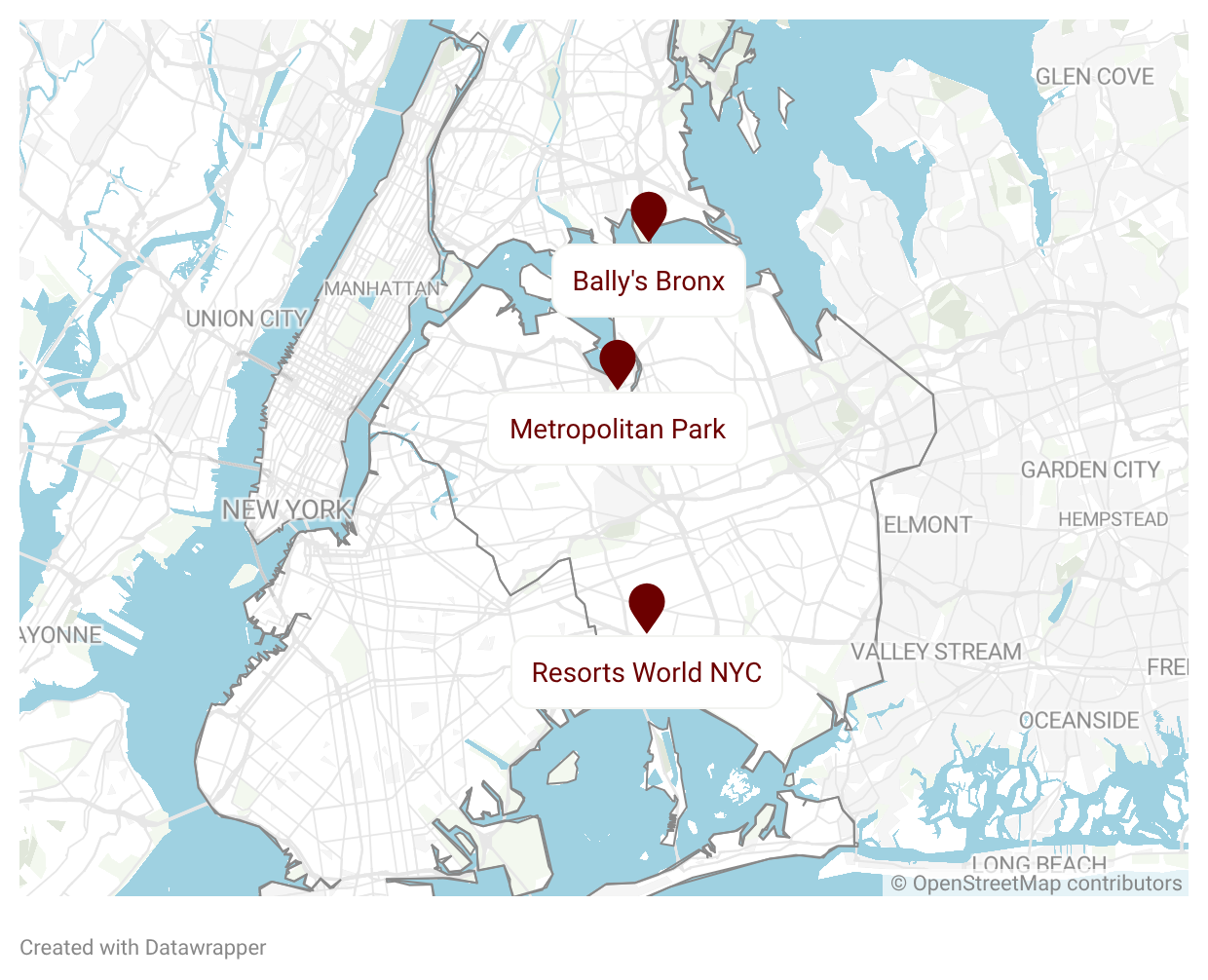
The 10-year moratorium on downstate casinos ended in 2023 and the New York State Gaming Commission is expected to issue up to three casino operator licenses by the end of 2025. At the time of writing in December 2025, local Community Advisory Councils, the New York Gaming Facility Location Board, and the New York Gaming Commission have approved three casino proposals in New York City to receive licenses. A fourth proposal in Yonkers was approved by the local Community Advisory Council but withdrawn by the operator. The three successful commercial casino bids are:
- the Bally’s Corporation golf course site in the northeast section of the Bronx,
- Steve Cohen and the Hard Rock Corporation’s Metropolitan Park site next to CitiField in northern Queens, and
- the expansion of the existing Resorts World New York City racino at the south Queens Aqueduct Race Track into a full-service commercial casino.
Each license awardee will pay a $500 million license fee, in addition to its promised community benefits package and future gambling taxes. In its decision document, the Gaming Facility Location Board expressed concerns about the selected casinos’ commitments to diverse workforces, problem gambling mitigation measures, climate resilience efforts, and certain other non-binding but prominently advertised community benefit commitments. The Board recommended the Gaming Commission and the New York State legislature take action to address these concerns and make all promised community benefits binding.[4]
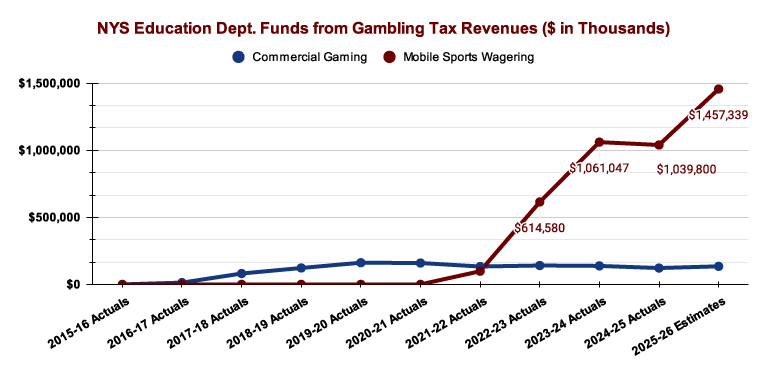
New York levies significant gambling taxes: 51% for sports betting corporation profits and about 25-45% for casino profits, depending on the particular casino. These taxes have brought in billions of dollars annually, the vast majority of which go to fund public education, though by displacing rather than adding to general education funds. Smaller amounts of gambling tax revenue go to gambling addiction treatment programs, transportation, and general funds.[5] While these contributions should not be understated, gambling’s potentially devastating public health effects cannot be ignored.
State legislators included provisions in authorizing statutes that mandate gambling tax revenues be invested in addiction treatment and youth programs, showing policymakers take gambling harms seriously. However, the scholarship on gambling, particularly those studies published in the years since commercial casinos and online sports betting were legalized, suggests that the state’s existing investments are insufficient in both volume and scope.
This report reviews scholarship on gambling and its effects in order to make policy recommendations for mitigating existing and potential gambling harms in New York City and New York State. Particular attention is paid to gambling’s public health effects and economic impacts on both individuals and communities. Gambling addiction is a serious and prevalent problem, and the evidence suggests that legalizing sports betting and opening new casinos can exacerbate addiction and other mental health problems. The practice has also been associated with a significant increase in domestic violence, particularly economic exploitation. While gambling taxes undeniably raise huge sums for public programs, the literature suggests that the positive economic development effects of new casinos are likely overstated, particularly for urban areas. Gambling is associated with negative changes in participating individuals’ financial well-being, which itself may result in poorer physical health. Lastly, gambling and new casinos may be associated with worse educational and crime outcomes, though the evidence in these areas is less conclusive.
New York City and State can take several actions to mitigate these potential harms. At the local level, we can launch an interagency Gambling Harms Mitigation taskforce, create better connections between related municipal programs, create a Gambling Harms Mitigation Fund, and expand problem gambling educational efforts. New York State could improve or increase enforcement of a number of gambling regulations in the areas of data reporting, employee training, consumer wager limits, and advertising. It could also mandate that new casinos develop anti-displacement plans to prevent the flight of local residents and businesses.
New York can’t afford to play roulette with its future. Gambling raises significant sums to fund important initiatives, but we must ensure we do not place revenue raising over the real risks to New Yorkers’ health and prosperity. It’s time to pull the lever to align our actions with our values. There are many steps legislators and policymakers can take at both the municipal and state levels to combat gambling’s negative externalities. We can hit the jackpot, but we can’t leave New Yorkers behind.
New York’s Current Approach
The vast majority of existing regulation and programming in New York related to gambling harms operate at the state level. A small number of New York City regulations related to gambling do exist. Local Law 57 of 1997 regulated gambling “cruises to nowhere” but no businesses operating this kind of cruise currently operate in the city.[6] In 2013, the New York City (NYC) Council passed legislation by then-Council Members Jumaane D. Williams and Lew Fidler to automatically revoke amusement cafe licenses should they be found to engage in unlawful gambling activities.[7] In 2017, the NYC Council passed legislation by then-Council Member Ritchie Torres preventing the return of funds or items seized by the NYPD if they were originally obtained via illegal gambling.[8] Other municipal regulations identify particular standards for casino buildings, such as air flow rates.[9]
As far as we could find, no municipal regulations or services exist that directly address the gambling harms outlined in this report. Of course, New York City provides many services, such as supports for domestic violence survivors or financial counseling programs, that address harms that research has associated with gambling without highlighting the programs as such.
New York State policymakers acknowledge that the public health risks of gambling exist, even if the state’s measures do not address every potential negative effect of gambling and are not proportionate to the issue’s severity. These acknowledgements take the form of statutory and regulatory limitations and programs funded by gambling tax revenue.
State gambling regulations largely focus on advertising and problem gambling. Misleading or false statements are banned, customers must be able to opt out of direct advertising, and intentional advertising to underage New Yorkers or in university news outlets are prohibited. Gambling operators must pay set fees into problem gambling treatment funds, in addition to taxes. Operators must also develop problem gambling plans that include measures to prevent minors from participating. New York State requires that gambling advertisements reference addiction HOPEline services.[10]
State law grants regulators control over allowable mobile wagering menus for mobile sports gambling apps. For example, bets cannot be placed on negative occurrences within sports events (e.g., one cannot bet on goals missed or fouls called). Some other states allow wagers on non-sports events, like media awards show outcomes. Further, New York State statute allows regulators to set maximum permissible wagers and to decide on which sports bets may be placed.[11]
Gambling Taxes
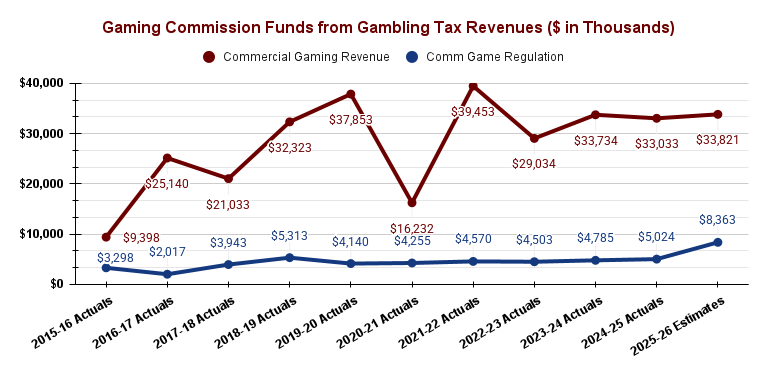
Despite their potentially overstated effects on local economic development (see the relevant Literature Review section), casinos and other gambling activities have undoubtedly raised enormous sums in tax revenue for New York State and some localities. Commercial casinos have contributed $1.24 billion in gaming tax revenue from their launch in late 2016 to the end of the state’s Fiscal Year 2024-25. Most years, commercial casinos raise between $160 million and $170 million. Racinos and other VLT operators have contributed a total of $8.76 billion in tax revenue in the same time period and have raised close to or slightly over $1 billion each year for the last several years. While there are just four operating commercial casinos, there are now twelve operating VLT establishments.[12] So while VLTs have contributed more in total, commercial casinos have each individually contributed quite a bit more than VLT venues.
Each particular casino game is taxed at a different rate, so each casino and VLT venue has a different tax liability percentage dependent on their offerings. However, the New York State legislature reduced tax liabilities for most commercial casinos in Fiscal Year 2021-22, moving from between 30-33% on average to below 25% in the years since.[13- In exchange for reduced tax rates on slot machines, which make up a large portion of most casinos’ offerings, operators had to agree to stricter fiscal reporting requirements and stricter adherence to employment goals. Non-compliance would have led operators to pay the same or increased tax rates on slot machines but all operators complied. See New York State Laws of 2021, Chapter 59, Part GG.] 80% of this revenue goes to New York State, which uses it primarily for education funds, while 10% each goes to the municipal and county governments of localities hosting casinos. The New York State Comptroller’s 2023 Upstate Casino Revenue Impact report, however, indicates that these facilities made much less than projected revenues and thus produced much lower tax revenue. Even so, three of the four casino host communities were able to use gaming tax revenues to significantly reduce their property tax collections.[14]
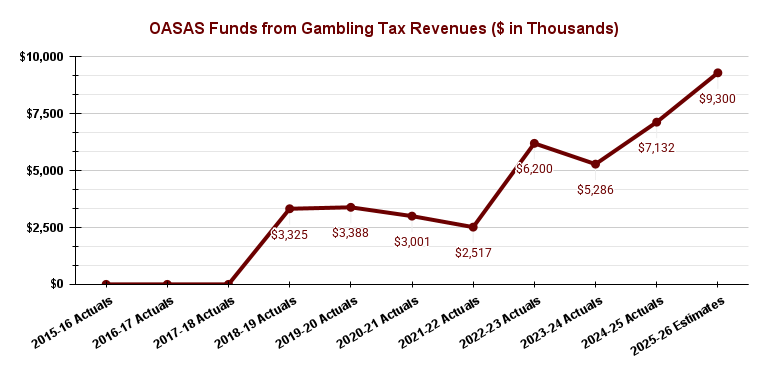
$9.3 million of New York State’s FY2025-26 gambling tax revenue is allocated for education on and treatment for problem gambling.[15] This money is administered by the Office of Addiction Services and Supports (OASAS) and funds the New York Council on Problem Gambling (NYCPG)’s many Problem Gambling Resource Centers, training on problem gambling for healthcare providers, and problem gambling treatment providers who specialize in serving uninsured New Yorkers.[16] New York State also funds financial counselors who specialize in working with problem gamblers.[17] These investments in addressing gambling’s negative public health effects are significant. However, they are insufficient in scope and do not sufficiently address gambling’s effects on gamblers’ loved ones or on New Yorkers living and working in proximity to gambling venues. In 2023, lawmakers also set aside some future casino tax and license fee revenues for the Metropolitan Transportation Authority (MTA), which expects to receive $500 million from these funds in 2026 and in 2027, $600 million in 2028, and $200 million in 2029.[18] The MTA is set to receive 50% of gambling tax revenues from the Bally’s and Hard Rock casinos and a variable amount of revenue from the Resorts World NYC casino, dependent on education funding targets. The remaining revenue from the new casinos will go to the New York State Department of Education.[19]
From its legalization in January 2022 to the end of FY2024-25, online mobile sports gambling has contributed about $2.9 billion to New York State coffers. Mobile sports betting’s annual revenue contributions have increased steadily since 2022; they reached over $1.1 billion in FY2024-25 and are on track to surpass that amount in FY2025-26. This large amount is likely attributable to sports betting’s high participation volume and 51% tax rate on profit. The vast majority of mobile sports gambling tax revenue goes to the state Education Department, though significant sums go to addiction services and the state’s gambling regulator, the New York State Gaming Commission.[20]
Literature Review
Addiction and Mental Health
Gambling addiction, sometimes called problem gambling, pathological gambling, or a gambling disorder, is characterized by gambling behaviors that are both compulsive and disruptive to an individual’s social life and executive functioning.[21] About half of adults and almost a fifth of adolescents report gambling in the last year, while the literature estimates that this behavior amounts to problem gambling for slightly over 1% of adults.[22] The most common risk factors for problem gambling are internet gambling, continuous play machine (such as slots) use, and poker. Mental health difficulties, particularly substance use, and family members with gambling histories are also strong risk factors. Problem gambling rates among youth tend to be higher in areas with higher income inequality.[23]
The COVID-19 pandemic was associated with a major shift from in-person to online gambling.[24] OASAS reports a large increase in problem gambling treatment utilization since at least 2020, with particularly large increases following the legalization of mobile sports betting in 2022. New York State’s gambling “HOPEline” reported a 26% increase in calls in the first year of legal mobile sports betting, though sports betting accounted for just 20% of the gambling revenue during the same time frame. Although calls to this line have remained steady in the years since, callers now cite online gambling as their top concern.[25]
The connection between sports betting and problem gambling appears particularly strong. Studies indicate that this association may go in both directions – those with problem gambling symptoms may be more likely to bet on sports and higher levels of sports betting may be associated with subsequently higher levels of problem gambling. The strongest predictor of problem gambling for an individual sports bettor is the amount of money spent.[26]
Systematic reviews have also shown a strong correlation between nearby gambling availability and gambling disorders, indicating that casinos may attract or create problem gamblers in their vicinity.[27] Knowing this correlation and that problem gambling is often accompanied by other mental health difficulties, it is perhaps unsurprising that casino presence has been associated with a statistically significant 1-2% increase in the number of suicides within a county.[28] Evidence also strongly suggests that dopamine antagonist drugs, prescribed to treat certain mental illnesses and gastrointestinal problems, can induce problematic gambling behaviors.[29]
One of the largest studies on gambling analyzed the real financial data of millions of British citizens alongside lifestyle surveys and five year outcomes. It found a number of worrisome correlations. While the study did not consider suicide rates as above, it did find that increased gambling volume was associated with significantly higher mortality, disability, and spending on fast food, gaming, bars, and tobacco. High-volume gamblers were also less likely to spend time on self-care, fitness, and socializing.[30]
Notably, many casinos derive the vast majority of their revenue from problem gamblers. In Massachusetts, the proportion of casino revenue from problem gamblers increased in the years after casinos first opened, from 74% initially to 90% in 2022.[31 - Volberg, Rachel, Valerie Evans, and Shawna Black. Problem Gambling Services in New York State: Review, Assessment, and Recommendations.] Taken together, the literature paints a worrisome picture of gambling’s mental health effects.
Local Economic Development
Casino operators and other gambling business owners often tout large local investments and positive economic effects as primary reasons that local governments should support new casinos. The New York State Gaming Commission thus considers each casino bid’s local investment commitments as a central factor for its license awards.[32] However, the research on the actual economic development impacts of new casinos is mixed and effects appear to depend heavily on the particular casino location type and clientele.
Generally speaking, economists believe that casinos’ economic benefits may be overstated. This is in part because, some systematic reviews argue, casino openings in small towns and rural areas are overrepresented in the literature. New casinos appear to benefit these areas much more than they benefit larger cities, where economic effects are more likely to be negative. These effects occur because rural casinos often introduce new entertainment and related industries and so induce new spending from outside visitors. Cities tend to already have these industries, so new urban casinos are more likely to displace existing spending.[33] “Destination gambling” casinos that attract out-of-area gamblers tend to have larger positive economic impacts than “convenience gambling” casinos that primarily serve local residents. Convenience gambling likely harms the revenues of nearby non-casino entertainment, restaurant, bar, and merchandise businesses, while destination gambling may support them.[34]
Casinos themselves do create both temporary and permanent jobs, but their impacts on local non-casino job growth are also often overstated. A recent quasi-experimental analysis of U.S. casino openings from 2000 to 2020 used a control group of areas with unsuccessful casino development bids. This is a stronger approach than comparing areas with casinos to all areas without casinos. This study found that casinos do create new non-casino jobs in the immediate vicinity of a new casino, but that this effect decreases and then reverses the farther one gets from the casino. Thus, at the neighborhood level, casinos’ net job creation effect was actually zero. The hyper-local jobs that were created spanned industries, but were concentrated in hospitality. The jobs lost were concentrated in industries other than hospitality, both for jobs in the immediate vicinity and farther out from a casino.[35]
One review of the limited available research on casino openings in the Northeast United States found that urban casinos usually open in low socioeconomic communities with some pre-existing gambling culture. This review highlights the lack of research on socioeconomic outcomes for areas near urban casinos and questions whether the literature can accurately claim that casinos benefit local economies when studies have not priced in their social costs.[36]
Little research has been published on the particular effects of the Resorts World New York City racino that opened in Queens in 2011. A recently published Master’s thesis references a report from the Queens Chamber of Commerce claiming that restaurants, small retailers, and service providers within one mile of Resorts World NYC reported higher patronage and a 20% increase in weekday sales.[37] However, we could not locate this report and no publicly available data exists to corroborate or refute it. Further, a different study found that proximity to Resorts World NYC was associated with higher poverty outcomes in both the first and fifth year after opening.[38]
There is limited research on the effects of new casinos on housing and potential resident displacement. On average, casinos reduce nearby home loan values by 6 - 7% over 3 years after opening. Conversely, faster legal gambling growth has also been associated with both housing bubbles and higher income inequality.[39] The Urban Institute has expressed concern about the displacement potential of the proposed Metropolitan Park casino in northern Queens, pointing to research indicating that large developments raise nearby rents. Gambling harm mitigation strategies, they argue, should consider the potential for displacement alongside financial and environmental harms.[40]
Financial Health
Even as gambling raises enormous sums for New York State and its municipalities, the practice often has a detrimental effect on the financial lives of gamblers and their loved ones. There is less published research on the relationship between casinos and the financial health or financial well-being of nearby residents than there is on the relationship between sports gambling and financial health. Importantly, though, there is some evidence that casinos may lead to an increase in bankruptcy filings in their host counties.[41] Gambling in general has been associated with increases in financial stress.[42]
Research indicates that the legalization of sports betting is associated with significant effects on both aggregate and individual financial health. These effects occur through increases in credit card balances, lottery play, and overdraft frequency alongside decreases in available credit, savings, and net investments. Sports betting’s aggregate effects on financial health may displace some of the tax revenue it produces. The financial health impacts of sports betting are particularly concerning because they are concentrated in households already experiencing financial distress. These associations are also very troubling because many sports bettors, despite understanding its addictive nature, report believing that the practice could improve their financial situations.[43]
Importantly, sports betting’s impacts on financial health may further exacerbate other health problems. Financial security and the ability to successfully make good financial decisions are both positively associated with self-reported measures of both physical and mental health. While the research considering the relationship between objective measures of physical health and financial stability or financial distress are less conclusive, there is a strong positive correlation between financial distress and depression. The mechanism for this relationship is under-researched but it likely goes in both directions.[44]
Domestic Violence
Domestic violence, particularly intimate partner violence, has a well-documented but under-discussed correlation with gambling. Gambling research reviews suggest that there is a strong relationship between gambling, particularly problem gambling, and domestic violence.
Most frequently, gambling-related violence affects the intimate partner of the gambler, but other family members are often affected as well. Among survivors of gambling-related intimate partner violence, economic exploitation is the most commonly reported form of abuse. Physical violence was reported less than other abusive behaviors. Stigma of both problem gambling and intimate partner violence often prevents survivors from seeking help.
The research is not conclusive on whether gambling itself causes this form of violence. Rather, the authors of at least two systematic reviews believe the evidence points towards a bidirectional relationship in which stress related to their own or their partner’s gambling intensifies violence from those already perpetuating or likely to perpetuate it.
It is important to note that the correlation between gambling disorders and intimate-partner violence exists for both perpetrators and victims, though it appears stronger for perpetrators. For survivors, gambling can be an emotional and physical escape from an abusive environment.[45]
Most of the research on this topic considers gambling in general, as highlighted above. Little published research exists on the specific relationship between casinos and domestic violence. It does not seem unreasonable to assume that the increase in gambling spurred by new casino development would also lead to an increase in domestic violence. However, the relationship between sports gambling and domestic violence incidents is increasingly well documented.
A recent working paper looks at betting on football games in the United States and finds that states with legalized online sports gambling experienced a 10% increase in intimate partner violence after an upset loss. This effect was largely driven by states where online sports betting is legal, like New York, indicating that the effect here is likely larger than 10%. That this uptick follows surprising losses would support the above notion that gambling-related intimate partner violence is driven by periodic, rather than overall, increases in gambling-related stress.[46]
Domestic violence homicides in New York State decreased from 2022 to 2023, when sports betting was legalized. At the same time, orders of protection, strangulation arrests, and the number of participants in the state’s Address Confidentiality Program all rose in the same time period. Notably, the number of extreme risk protection orders more than doubled in that time period.[47] While calls to the NYC domestic violence hotline have declined to pre-pandemic levels, the number of NYPD domestic violence incident reports and the number of visits to the City’s Family Justice Centers have risen slightly each year since 2020.[48] It is unclear whether these increases are related to the legalization of mobile sports betting in 2022 and it is important to acknowledge that the entire country saw sustained increases in domestic violence following the COVID-19 pandemic.
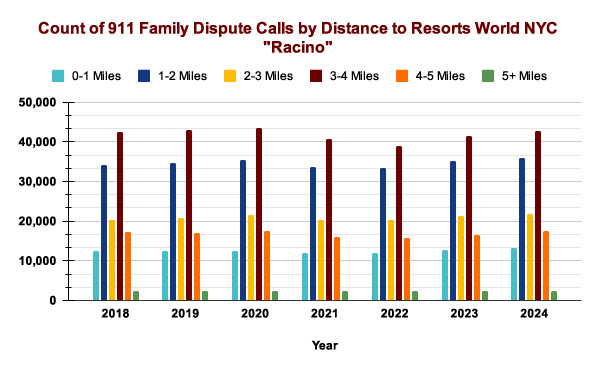
A descriptive analysis by the Office of the NYC Public Advocate (see below) using publicly available NYPD 911 call data finds many more calls related to family disputes within five miles of the Resorts World NYC racino than five or more miles away from it. Notably, the highest volume of calls were initiated from a middle distance of between 3 and 5 miles of the racino. Public data was unfortunately not available for years before 2018, which makes it difficult to determine whether Resorts World NYC’s 2011 opening affected family dispute call volumes. It is also important that many 911 calls regarding incidents related to domestic violence also receive codes other than family dispute. This analysis should be understood as a launching point for future research.
Workers at Safe Horizon, an organization providing services for domestic violence survivors, confirmed to the Office of the NYC Public Advocate that they have served New Yorkers experiencing financial abuse related to another party’s gambling addiction. They were unsure, however, about the extent of this kind of abuse and whether it was related to a particular kind of gambling or geographic area.
Crime
Some research has identified a relationship between gambling and certain kinds of crime. One systematic review finds that crimes related to gambling are usually non-violent and income generating, though problem gamblers may commit violent crimes at higher than average rates. Studies of prison detainees indicate that this population has a much higher than average propensity for problem gambling, up to twenty times the rate among non-inmates in some studies.[49] However, in both the case of crime generally and gambling among inmates, research has not definitively determined the direction of causality. It may be possible, for instance, that a higher than average risk tolerance could drive someone to both gambling and crime.
Several researchers have tried to determine whether there is a correlation between casino openings and nearby crime. One 2017 paper found that counties with new casinos saw a six year increase in aggregate crime and adjacent counties saw shorter-term increases. In both cases, crime levels declined over time such that the long-term effects were negligible.[50]
A 2024 study of the effects of casino openings in Massachusetts found no significant changes in crime overall. However, more granular explorations found that violent crimes and property crimes decreased while crimes with theoretical relationships to gambling, such as fraud, theft, domestic violence, extortion, and prostitution, increased in host communities. This study also found a significant increase in traffic volume and traffic accidents in host communities after casino openings.[51]
A 2019 review found that 59% of studies on casinos and crime show no major increase in local crime, about a third found that some crimes increased and others decreased, and the remaining studies found an overall increase in crime after casino openings. The primary takeaway from this review, though, was that studies on the relationship between new casinos and crime largely do not consider how casino openings may change factors related to crime, such as increases in police presence and the number of out-of-area visitors. In particular, few of this study type used non-casino jurisdictions as comparisons.[52] It is therefore difficult to make a firm conclusion about the relationship between casino openings and nearby crime, except to say that a positive correlation may sometimes occur for some crime types.
Education
The relationship between gambling and education, whether for students who gamble or those in proximity to gambling, is under-researched. One 2015 study found that casino openings in Massachusetts had no significant financial impact on schools.[53] A 2019 study indicates that Native American children may see a slight increase in high school graduation rates a generation after casinos open on rural reservations. This effect is likely spurred by the new resources these casinos bring to reservations and highlights how casino openings can particularly benefit rural areas.[54]
One study from Spain finds that in-person sports betting locations were associated with sustained decreases in nearby high schools’ educational performance and that these decreases exacerbated educational inequalities.[55] The mechanism for this decrease and whether mobile betting, rather than in-person betting, may affect educational outcomes are unclear. New York has age restrictions on mobile betting but there were at least 100 documented cases of alleged underaged sports betting in 2022 and 2023, and likely more cases that were not documented.[56]
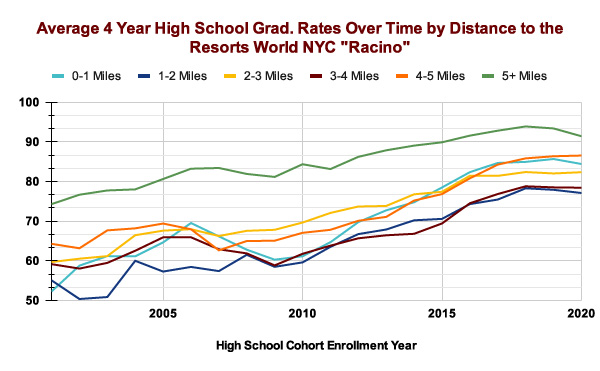
A descriptive analysis by the Office of the NYC Public Advocate (see below) indicates that high schools located within five miles of the Resorts World NYC racino saw consistently lower four-year graduation rates than those five or more miles away. This gap existed before the racino opened in October 2011 and has decreased over time, so it is likely a better indicator of where casinos tend to be placed in urban areas, namely in lower socioeconomic areas, than of effects from Resorts World NYC. Importantly, this investigation did not test statistical significance or causality.The rapid increase in the average graduation rate of high schools within one mile of the racino might support this theory because the increase followed the creation of the Foundation Aid Formula with larger investments for schools in low-income areas, improved data collection and assessments, and measures to give principals more control over school budgets in 2007.[57 - Alliance for Excellent Education, New York City‘s Strategy for Improving High Schools: An Overview.] The effects of sports betting, particularly via mobile platforms, and casino gambling on education in the United States and in New York are important areas for future research.
Recommendations
The above literature review highlights the many potential dangers arising from legalizing online sports betting and opening new casinos. The time to debate whether New York should expand gambling in these ways has, unfortunately, passed. Online sports gambling is already widely popular and state law mandates new casino license issuances by the end of 2025. The best approach for legislators and policymakers is now one of harm mitigation.
Using a number of government actions, we can preempt or treat the worst potential side effects of gambling expansions. This section breaks down avenues for action, split up at the municipal level by legislative and executive measures. The most wide-reaching and effective actions must be taken by New York State because state legislatures and agencies govern gambling regulations and taxation. Even so, New York City can do a lot to study the effects of new casinos, educate residents, and expand and streamline related programs.
City
LEGISLATIVE
The following actions should be taken by the New York City Council.
- Create a Gambling Harms Mitigation Task Force in order to coordinate data collection and analysis, policy development, and service delivery related to gambling harms. This Task Force should be composed of civil servants and experts in gambling and related harms appointed by Council Members, the Mayor, the Public Advocate, the Comptroller, and Borough Presidents. Its core responsibility will be to study and make recommendations regarding the socioeconomic and geographic effects of gambling, including but not limited to potential effects on domestic violence, crime, education, and economic development outcomes. The Task Force should meet several times in its first year to set data baselines and create recommendations for related policy, programs, and research. It should then meet at least once annually in subsequent years to review data and revise action plans, if necessary. It should report to Council at least once annually. If possible, it should work closely with those conducting the State’s recently announced 10-year gambling health trends study.
- Expand the Financial Literacy for Youth initiative citywide and incorporate a gambling harms module in the program’s curriculum. This program was created by Mayor Eric Adams alongside the Department of Consumer and Worker Protection and will launch in 15 public school districts during the 2025-26 school year. It is currently on track to expand citywide by 2030. However, with a City Council mandate and funding, we could ensure that this important initiative reaches every New York City public school student well before 2030. Our youngest New Yorkers will likely spend most of their lives in a New York City that will shortly be home to at least three casinos and in which online sports betting is extremely accessible. Thus, it is vital that all currently enrolled students receive education on gambling harms, with a focus on risk awareness and responsible decision-making, so they are prepared to recognize and address problem gambling in both themselves and others. This expansion is particularly important, in part, because a 2025 report written for OASAS found that New York State has not yet followed the best practice of focusing gambling problem prevention efforts on young adults who are not pursuing higher education.[58 - Volberg, Rachel, Valerie Evans, and Shawna Black. Problem Gambling Services in New York State: Review, Assessment, and Recommendations.]
- Add problem gambling risk screening questions to relevant intake forms for mental health, substance use, supportive housing, and other services run by New York City agencies, such as the Departments of Social Services, Homeless Services, and Health and Mental Hygiene. This addition will prove helpful for connecting residents to the services they need. They will also play a vital role in data collection, allowing municipal agencies and the Gambling Harms Mitigation Task Force to better understand the prevalence, socioeconomics, and geographic distribution of problem gambling risk.
EXECUTIVE
The following actions should be taken by the New York City Mayor and agencies. It is likely that the Mayor and municipal agencies could also independently implement some of the Legislative recommendations in the previous section, should City Council be unable to act on them.
- Build partnerships across New York City agencies that address gambling harms and between relevant city and state offices, including the Mayor’s Office to End Gender Based Violence (ENDGBV), the Mayor’s Office for Economic Opportunity, the Department of Consumer and Worker Protection’s Office of Financial Empowerment (DCWP OFE), OASAS, and the New York State Gaming Commission. These partnerships, in addition to streamlining program referrals and data sharing, could enable a number of service delivery improvements. New York City could provide Financial Empowerment Center (FEC) counseling services in the Family Justice Centers (FJCs) and inside or near to new casino locations. FEC counselors should be trained to identify domestic violence risk factors and train both FEC and FJC staff on gambling risks, with emphasis on economic exploitation.
- Place a predetermined portion of local commercial casino tax revenue into a Gambling Harms Mitigation Fund. New York City will likely receive between 10% and 20% of the gambling tax revenues from casinos in its jurisdiction, assuming the state decides on a revenue structure similar to that of upstate casinos. The Mayor and the City Council should work together to set aside a consistent percentage of these tax revenues in a fund dedicated to funding the above programs and others that address the potential negative side effects of gambling. Considering that New York City and State are projected to receive about $1 billion from the new casinos’ tax revenue,[59] it seems reasonable for the City to set aside at least 20% of its share to address gambling harms. This Gambling Harms Mitigation Fund should be used to fund the research and other activities of the Gambling Harms Mitigation Task Force, as well as to provide resources to other services that prevent and treat problem gambling and related harms.
- Run a citywide educational advertising campaign about problem gambling and gambling harms to coincide with the opening of the three new casinos and major sports betting events. The City should partner with OASAS on the content for this campaign and, if possible, concentrate advertisements in the vicinities of the new casinos and sports venues. Running social media, television, print, and in-person educational advertisements will allow New York City to educate a wide swathe of New Yorkers on how to identify and treat problem gambling and related maladies. This campaign should also connect New Yorkers to services for survivors and for financial counseling, as well as any other programs that could mitigate gambling’s negative externalities.
State
LEGISLATIVE
Members of the New York State legislatures should take the following actions. The most robust and long-lasting gambling regulations must be updated within state law, though there are likely smaller aspects of the recommendations in this section that could be implemented by the Governor or state agencies.
- Improve data collection and reporting requirements for gambling operators to enable monitoring and future research. New York State should require that these organizations collect and provide regulators with de-identified information about user gambling practices, including individual-level wager amounts and geographic data for mobile sports betting. New York should then aggregate these data to create a public gambling data portal and dashboard to enable live monitoring and future research.
- Strengthen regulations on gambling particulars to reduce the risk of problem gambling among participants. Experts recommend that both in-person and online gambling restrictions be opt-out rather than opt-in. Casino or mobile sports betting customers should be required to set wager ceilings or time limits for themselves prior to gambling activities, with the option to opt-out. New York State should ban tiered benefits, which casinos implement to encourage customers to place more and larger wagers in order to receive perks at in-casino establishments, such as restaurants.[60 - Betting on Development? The Promise and Perils of Casinos in New York.] New York should also provide modest financial incentives to frequent gamblers who opt in to the existing self-exclusion program. Financial incentives have proven effective for encouraging abstinence from substances, such as nicotine and alcohol.[61]
- Allocate a fixed percentage of gambling tax revenue to problem gambling prevention and treatment. It is laudable that New York State has created and funded many services for problem gambling and related harms. Even so, more should be done. The National Council on Problem Gambling (NCPG) recommends that 50% of the federal sports betting excise tax be allocated for problem gambling treatment.[62] This tax is smaller and differently structured than New York State’s gambling taxes but is a good model structure for determining how much the state should spend on problem gambling services. Rather than producing a flat funding number with each budget, New York State should tie problem gambling service funding to a percentage of gambling tax revenues, thus linking services to participation and actual need, with a new funding floor well above the current $9.3 million.
- Decouple gambling tax revenue from education funds. Currently, the majority of tax revenue from gambling funds education by displacing, rather than supplementing, money from the general fund. Linking education funding directly to gambling tax revenue creates a perverse incentive to increase gambling participation, which may itself have negative effects on educational outcomes. Instead, gambling tax revenues not used for problem gambling services should go into New York State’s general funds, which should then fund the Education Department with reasonable baselines.
- Strengthen gambling advertisement regulations. New York State already requires that gambling advertisements include information on addiction risks and the HOPEline’s contact information, with specific requirements that ensure their visibility.[63] New York should extend this requirement so that it also includes information on how to access free, local financial counseling. It should strengthen the visibility requirements so that it is harder for individuals to miss or ignore the risks of and supports available for gambling addiction. Legislators should consider a full ban on casino advertising within a mile radius of each facility, so as to minimize the negative outcomes associated with casinos that primarily attract local residents rather than tourists. New York State bans sports betting advertising on university campuses, but it should expand this regulation to all gambling advertisements and to include advertising in the proximity of middle and high schools. To further avoid gambling advertisements reaching those under age, legislators should consider bans on gambling advertising on public transit and during television shows or on internet videos targeted towards youth. It is particularly vital that the state ban algorithmic and demographic targeting for gambling advertisements, as this practice could easily lead companies to target the most addiction-prone New Yorkers. OASAS and the New York Gaming Commission should also place information on gambling self-exclusion and the option to self-exclude front and center on their websites.
- Require doctors and pharmacists to provide information on the link between dopamine antagonist drugs and problem gambling, including resources for problem gamblers and their loved ones, when prescribing drugs of this kind. Dopamine antagonists have been reliably linked to the sudden onset of gambling urges.[64] Absent federal action, New York State should help avoid preventable gambling addictions by implementing these information provision requirements.
EXECUTIVE
Governor Kathy Hochul’s 2026 State of the State included a number of measures to address gambling addiction. These measures are laudable and efforts to launch a 10-year statewide study on gambling health trends will be particularly vital for future public health interventions. However, the Governor and executive agencies should go farther by taking the following actions. They should also implement aspects of the above legislative recommendations within their power, if the legislature does not pass them.
- Ensure that the recently announced 10-year gambling health trends study is sufficiently robust. This report should, at minimum, consider the relationships between in-person and online gambling and harms related to financial well-being, physical and mental health, family and relationship dynamics, employment and education outcomes, and illegal activity. It should consider impacts at both the statewide and local levels, particularly areas near new gambling establishments. To ensure that government officials and providers of prevention and intervention programs are sufficiently informed, the study should publish interim reports every two years.
- Implement all recommendations in the 2025 Problem Gambling Services in New York State report commissioned by OASAS. That report explores the existing problem gambling services environment in New York State and finds that its practices are in alignment with a majority, but not all, of the international best practices for preventing and treating problem gambling. It makes a wide variety of pertinent recommendations that would bring New York into alignment with best practices. The many recommendations in the Problem Gambling Services report would not fit here, but they include efforts to reduce the gambling industry’s financial reliance on people with gambling problems, options for improving treatment services, and research and evaluation strategies, among many others.[65 - Volberg, Rachel, Valerie Evans, and Shawna Black. Problem Gambling Services in New York State: Review, Assessment, and Recommendations.]
- Ensure casino employees are in compliance with training requirements and introduce stronger oversight measures. Recent research suggests that most problem gambling-related actions taken by gambling venue employees were limited to observation, documentation, and discussion with other staff. These results were not specific to New York State, which does have robust annual problem gambling training requirements for casino employees.[66] The results may indicate, though, that it is worth investing in more intensive and frequent oversight of casino employees and their training. New York should regularly review compliance with the required training and should implement regular, unannounced site audits to ensure casinos keep their employees prepared to interact with potential problem gamblers.
- Work with new casino operators to develop enforceable anti-displacement plans in order to prevent the loss of nearby businesses, jobs, or residents. These plans should exist in tandem with the casino operators’ promised community benefits. The Urban Institute recommends this process be modeled after the development of the 11th Street Bridge Park in Washington DC. Plans should thus include the creation or expansion of nearby community land trusts to stabilize housing prices and prevent resident displacement, alongside events educating residents on their rights as tenants or homeowners. They should also include local business procurement requirements that emphasize opportunities for small businesses, minority- and women-owned enterprises, and worker cooperatives. These local businesses could provide dining, cleaning, security, and other necessary services.[67]
Acknowledgments
Lead Author: Ariel Munczek Edelman, Senior Policy & Budget Associate
Additional support was provided by:
Veronica Aveis, Chief Deputy Public Advocate for Policy Rosie Mendez, Director of Legislation and Policy Cerimar Olivares, Legislative & Policy Associate Matthew Carlin, Deputy General Counsel
Design and layout created by: Luiza Teixeira-Vesey, Digital Marketing Specialist
Cover Image: Leon Pascal, Unsplash
The Office of Public Advocate would also like to thank:
Professor Rachel Volberg, University of Massachusetts Amherst Professor Greg Smithsimon, CUNY Brooklyn College
Jimmy Meagher, Senior Policy Director, Safe Horizon
Michelle Hadden, Executive Director, New York Council on Problem Gambling (NYCPG) Kristin Sweeter, Problem Gambling Resource Centers Director, NYCPG
Professor Heather Howard, Princeton University
Katiuska Polanco
This report can be translated into over 100 languages at no cost. Please contact us at officeadmin@advocate.nyc.gov for more information.